Billing Mental Health in the USA: A Practical Guide to Accurate Claims and Better Revenue

0
198

Mental health providers do more than help patients manage emotional and behavioral challenges—they also navigate a complex billing system that demands precision. From changing payer rules to evolving documentation requirements, billing mental health services has become one of the most detailed areas of healthcare administration in the USA.

Many practices lose revenue not because they provide poor care, but because of coding mistakes, incomplete documentation, authorization issues, or denied claims. Understanding the fundamentals of mental health billing can help providers reduce errors, improve reimbursement, and spend more time focusing on patient care.

Whether you operate a solo counseling practice, a psychiatric clinic, or a multi-provider behavioral health organization, having a clear billing process is essential for long-term financial stability.

Why Mental Health Billing Is Different

Mental health billing differs from many other medical specialties because treatment often involves ongoing therapy sessions, psychiatric evaluations, medication management, and telehealth appointments. Each service has unique billing guidelines that must align with payer policies.

Insurance companies also expect detailed documentation that supports the medical necessity of every visit. Even a small inconsistency between clinical notes and submitted claims can delay payment or result in claim denials.

Providers must balance quality patient care with administrative accuracy, making efficient billing workflows more important than ever.

Common Challenges in Billing Mental Health Services

Mental health practices face several obstacles that can affect cash flow and reimbursement.

Frequent Claim Denials

Claims may be rejected because of:

  • Incorrect diagnosis codes
  • Invalid procedure codes
  • Missing modifiers
  • Incomplete patient information
  • Lack of prior authorization
  • Documentation that does not support the billed service

Addressing these issues before claim submission significantly improves first-pass claim acceptance.

Changing Insurance Policies

Insurance requirements frequently change, especially for behavioral health services. Coverage limitations, session caps, and authorization rules can vary between payers, requiring billing teams to stay updated throughout the year.

Documentation Requirements

Clinical documentation should clearly explain:

  • Patient diagnosis
  • Treatment goals
  • Progress during each session
  • Medical necessity
  • Time spent with the patient

Well-documented records strengthen claims and reduce audit risks.

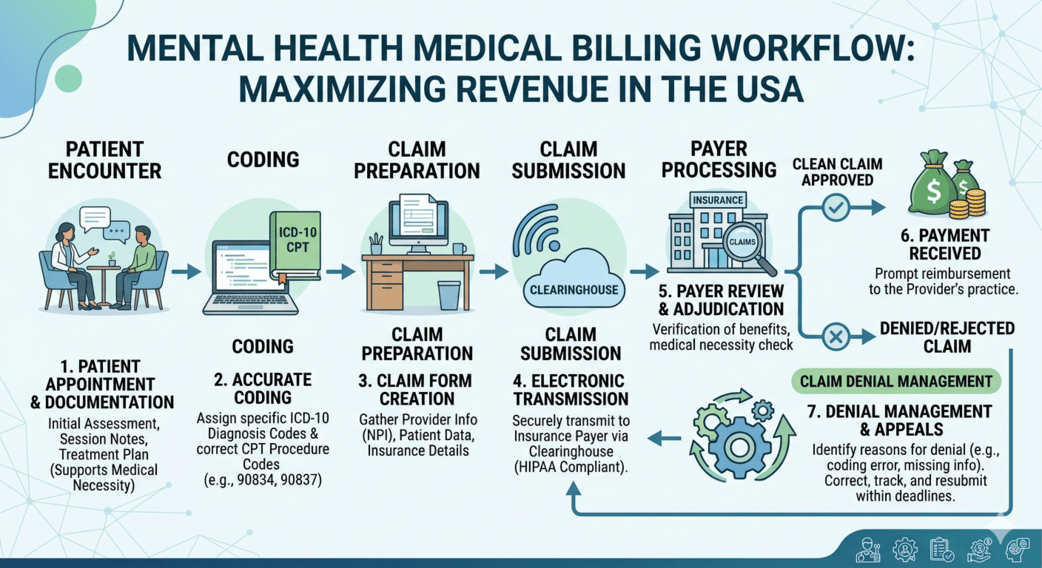
The Mental Health Billing Process Explained

A successful billing workflow involves much more than submitting claims. Every step contributes to accurate reimbursement.

Patient Insurance Verification

Before the appointment, verify:

  • Active insurance coverage
  • Mental health benefits
  • Copayment amounts
  • Deductible status
  • Referral requirements
  • Prior authorization needs

Early verification prevents unexpected billing issues after services are provided.

Accurate Coding

Coding accuracy plays a central role in successful reimbursement.

Providers should ensure that diagnosis and procedure codes match the services delivered and the documentation in the patient's medical record.

Combining accurate documentation with dependable medical coding services helps reduce billing errors while improving compliance with payer requirements.

Claim Submission

After coding is completed, claims should be reviewed carefully before submission.

A quality review should confirm:

  • Patient demographics
  • Provider information
  • Insurance details
  • Service dates
  • Procedure codes
  • Diagnosis codes
  • Required modifiers

Submitting clean claims improves payment speed and reduces administrative workload.

Payment Posting and Follow-Up

Receiving payment is not the final step.

Practices should regularly:

  • Post insurance payments
  • Review explanation of benefits (EOBs)
  • Identify underpayments
  • Appeal denied claims
  • Track outstanding balances

Consistent follow-up ensures that earned revenue is collected promptly.

Why Documentation Matters More Than Ever

Documentation is the foundation of successful mental health billing.

Insurance companies expect records that demonstrate why treatment is medically necessary and how the patient's condition is being managed.

Strong documentation should include:

  • Presenting concerns
  • Clinical assessment
  • Treatment plan
  • Progress toward goals
  • Interventions provided
  • Future recommendations

Clear documentation protects providers during audits while supporting accurate reimbursement.

Telehealth Has Changed Mental Health Billing

Virtual behavioral healthcare has expanded rapidly across the USA.

Many patients now prefer online counseling because it offers convenience and improved access to care.

However, telehealth billing comes with additional considerations.

Providers should understand:

  • Eligible telehealth services
  • Accepted modifiers
  • Place of service requirements
  • State-specific regulations
  • Payer-specific billing policies

Staying informed helps practices avoid payment delays for virtual visits.

Reducing Billing Errors Through Better Processes

Small improvements in workflow can produce meaningful financial results.

Successful mental health practices often focus on:

  • Regular staff training
  • Internal claim audits
  • Updated coding resources
  • Automated eligibility verification
  • Timely claim submission
  • Denial trend analysis

These proactive measures improve operational efficiency and reduce avoidable revenue loss.

The Importance of Credentialing

Insurance reimbursement depends heavily on provider enrollment.

Without proper credentialing, even correctly submitted claims may not be paid.

Credentialing involves verifying provider qualifications and enrolling them with insurance companies before services are billed.

Keeping provider credentials current helps prevent interruptions in reimbursement and minimizes administrative complications.

How Revenue Cycle Management Supports Mental Health Practices

Financial performance depends on every stage of the patient journey—not just billing.

Effective revenue cycle management covers:

  • Patient registration
  • Insurance verification
  • Charge capture
  • Coding
  • Claim submission
  • Payment posting
  • Denial management
  • Patient collections
  • Financial reporting

Monitoring the entire revenue cycle helps identify bottlenecks before they impact practice revenue.

When Should Practices Consider Professional Billing Support?

As patient volume grows, billing responsibilities often become more demanding.

Many behavioral health organizations seek outside support when they experience:

  • Increasing claim denials
  • Staff shortages
  • Slow reimbursements
  • High accounts receivable
  • Frequent coding updates
  • Administrative overload

Experienced medical billing services can help practices maintain billing accuracy while allowing providers to focus on delivering quality patient care.

Organizations like 247 Medical Billing Services support healthcare providers with structured billing workflows, coding assistance, compliance guidance, and revenue optimization while adapting to changing payer requirements.

Best Practices for Long-Term Billing Success

Mental health billing continues to evolve, making continuous improvement essential.

Practices can strengthen their financial performance by:

  • Reviewing payer policy updates regularly
  • Maintaining complete patient documentation
  • Verifying insurance before appointments
  • Monitoring denial patterns
  • Auditing claims periodically
  • Keeping coding knowledge current
  • Tracking key financial performance indicators

A consistent commitment to accuracy leads to stronger reimbursement outcomes and healthier practice operations.

Frequently Asked Questions

1. What is mental health billing?

Mental health billing is the process of submitting insurance claims for behavioral health services, including therapy, counseling, psychiatric evaluations, medication management, and related treatments.

2. Why are mental health claims often denied?

Claims may be denied because of coding errors, incomplete documentation, missing authorizations, incorrect patient information, or failure to meet payer-specific billing requirements.

3. How important is documentation in mental health billing?

Documentation is essential because it demonstrates medical necessity, supports the services billed, and helps providers meet insurance and audit requirements.

4. Does telehealth require different billing rules?

Yes. Telehealth services often require specific modifiers, place of service codes, and compliance with payer and state regulations.

5. What role does credentialing play in reimbursement?

Proper credentialing allows providers to participate with insurance networks and receive payment for covered services. Without it, claims may be rejected or delayed.

6. How does revenue cycle management improve financial performance?

Effective revenue cycle management streamlines every financial step from patient registration through final payment, helping reduce denials and improve cash flow.

7. Can outsourcing billing improve practice efficiency?

Many mental health providers benefit from professional medical billing services because experienced billing teams can reduce claim errors, improve reimbursement timelines, and manage complex payer requirements more efficiently.

Final Thoughts

Accurate billing mental health services requires much more than submitting insurance claims. Success depends on careful documentation, correct coding, timely claim submission, ongoing payer compliance, and proactive financial management. As behavioral healthcare continues to grow across the USA, practices that invest in efficient billing processes are better positioned to reduce denials, strengthen revenue, and provide uninterrupted care to their patients. By combining reliable medical coding services, effective credentialing, comprehensive revenue cycle management, and experienced support from organizations such as 247 Medical Billing Services, mental health providers can build a more sustainable and financially resilient practice.


Search
Categories
Read More
Other
Compact Tremolo Pedal Market to Reach US$198 Million by 2032 at 6.5% CAGR, Outlook 2025-2032
The global Compact Tremolo Pedal Market, valued at a robust US$ 120 million in 2024, is on a...
By Siddharth Maurya 2026-06-09 09:45:08 0 503
Other
The Future of Collaboration: Top Emerging Unified Communications Market Trends
The AI-Powered Communications Revolution The single most transformative trend shaping the future...
By Mrunali Pund 2026-06-23 05:34:22 0 341
Other
Forecasting the Shift toward BYOD (Bring Your Own Device) Models: Evaluating 2026 Gains in Patient Engagement and Cost Reduction (2025–2032)
In the rapidly evolving landscape of clinical research, the shift from paper-based protocols to...
By Avinash Kumbharkar 2026-04-07 08:30:37 0 1K
Other
Content Moderation Services Market Report Demand Rising Across Global Digital Platforms
The Content Moderation Services Market Report Demand is increasing rapidly...
By Akankshs Bhoie 2026-05-07 07:23:04 0 1K
Other
Cold Laser Therapy Market Share, Clinical Growth Trends, and Multi-Billion Dollar Forecast 2032
"Executive Summary Cold Laser Therapy Market Research: Share and Size Intelligence The...
By Prasad Shinde 2026-01-19 17:27:57 0 2K
Sponsored

🌍 Share the Gospel Across Every Language

People from different cultures and languages

Jesus said: "Go therefore and make disciples of all nations." (Matthew 28:19). Learning another language can help you share the Gospel, read Christian resources, communicate across cultures and reach more people with the message of Jesus Christ.

Whether you are preparing for missions, evangelism, ministry, travel or simply connecting with believers worldwide, mastering a new language can become a powerful tool for advancing God's Kingdom.

🌐 Start Learning a New Language
✝️ Explore the JesusChristLive.com Ecosystem