


- Web sayfası bildirimcisi
- EXPLORE
- Sayfalar
- Gruplar
- Events
- Reels
- Blogs
- Market
- Funding
- Offers
- Jobs
- Courses
- Forums
- Movies
- Oyunlar
- Developers
- Merits
-
 The Holy Bible: Read, Listen, Watch — All Versions, Concordance & Study Tools
-
 A.D. The Bible Continues - 01 - The Tomb Is Open
-
 New! Daily Confessions ~ Christian Audio Bible Study MP3 Series
-
 CHRISTIAN LIBRARY
-
 Donate | $
-
 Donate | Crypto
-
 About
About
-
 Terms & Conditions
-
 Gizlilik
-
 Earn Online
How to Create an Effective Performance Testing Strategy in 2026
A few years ago, I joined a project where the team had no formal performance testing strategy. They ran occasional load tests right before major releases, often discovering critical bottlenecks too late. The result? Delayed launches, frustrated users, and a lot of last-minute firefighting.
That experience made me realize something important: having good performance testing tools is not enough. You need a well-thought-out performance testing strategy that becomes part of your development culture.
In 2026, with AI-driven applications, cloud-native architectures, microservices, and ever-growing user expectations for lightning-fast experiences, a solid performance testing strategy is no longer optional — it’s essential for business success.
In this comprehensive guide, I’ll walk you through how to create an effective, practical performance testing strategy from scratch, whether you’re a startup or an enterprise. These steps are based on real projects I’ve worked on and helped implement at SDET Tech.
Step 1: Define Clear Objectives and Business Goals
Every strong strategy starts with “Why?”
Ask these questions:
- What are the key user journeys that must perform well?
- What response time and throughput targets align with business SLAs?
- How much traffic do we expect during normal and peak periods?
- What risks are we trying to mitigate (downtime, cart abandonment, SEO penalties, etc.)?
Best practice for 2026: Align performance goals with business KPIs. For an e-commerce site, this might mean “checkout page must load under 2 seconds even with 10,000 concurrent users.”
Document these objectives in a Performance Testing Charter or include them in your quality strategy document. Review them every quarter as the application and user base evolve.
Step 2: Understand Your Application Architecture
Modern applications are complex — distributed systems, serverless functions, third-party integrations, and heavy frontend frameworks.
Map out:
- Critical components and services
- Dependencies (databases, caches, external APIs)
- Scalability patterns (auto-scaling groups, load balancers)
- Technology stack (frontend, backend, infrastructure)
This understanding helps you decide what and where to test. For example, in microservices architecture, you might focus heavily on API performance and service-to-service communication.
At SDET Tech, we always begin client engagements with an architecture review and performance risk assessment. This step alone prevents many common mistakes.
Step 3: Identify Key Scenarios and User Journeys
Don’t test everything — focus on what matters most.
Prioritize:
- Core user flows (login, search, checkout, payment, etc.)
- High-traffic pages or endpoints
- Resource-intensive operations (report generation, file uploads, AI features)
- Seasonal or event-driven scenarios (Black Friday, flash sales)
Create realistic test scenarios based on production analytics, not assumptions. Include different user personas — mobile users on slow networks, users from different geographies, etc.
Step 4: Choose the Right Mix of Testing Types
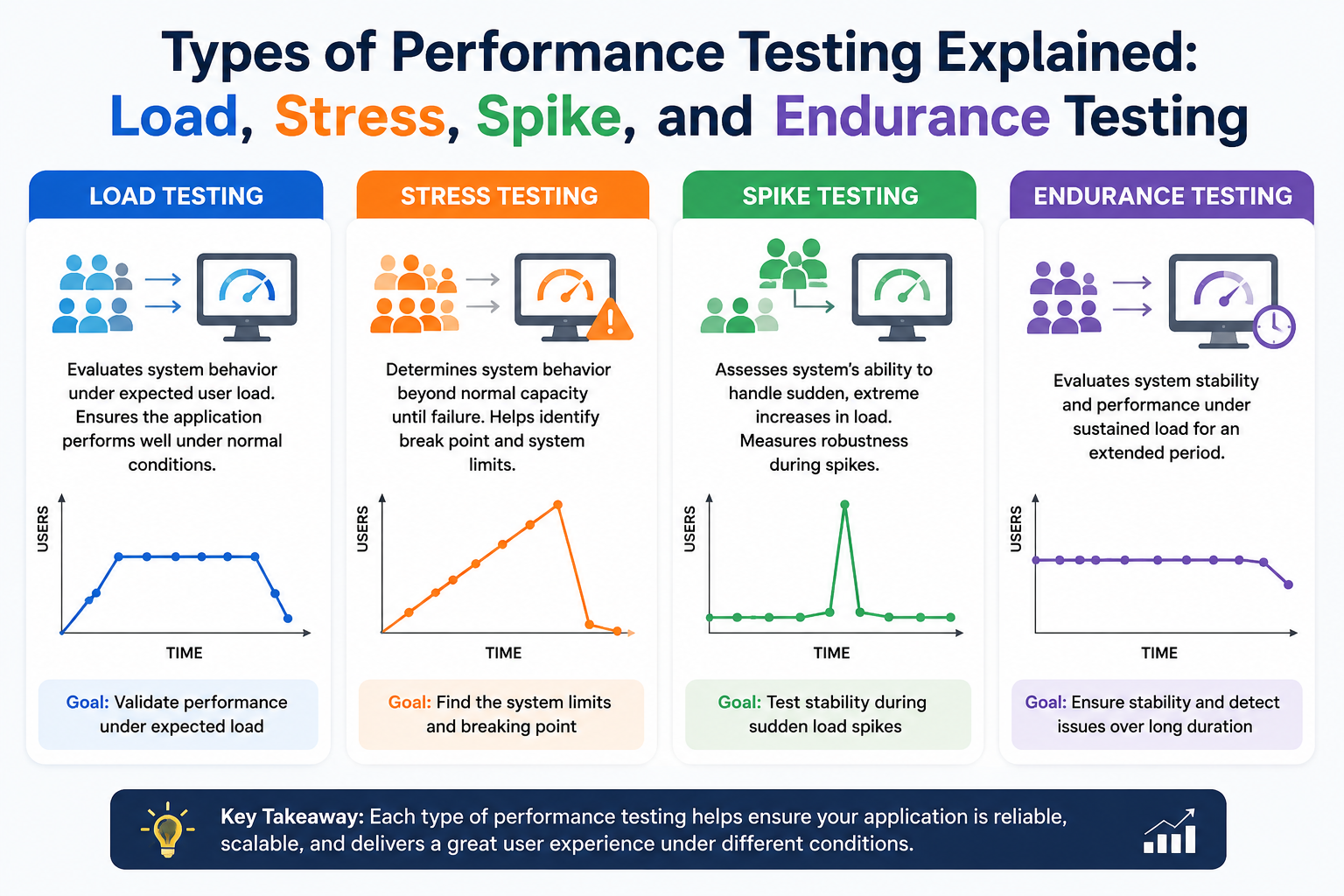
An effective performance testing strategy combines multiple testing types:
- Load Testing: Simulate expected traffic
- Stress Testing: Find breaking points
- Endurance/Soak Testing: Check long-term stability
- Spike Testing: Handle sudden traffic surges
- Scalability Testing: Validate auto-scaling behavior
- Component/API Testing: Early-stage testing of individual services
Decide the frequency for each type. For example:
- Component-level tests → Every sprint
- Full load tests → Weekly or before major releases
- Soak tests → Monthly
Step 5: Select Tools and Infrastructure
Choose tools based on your tech stack and team skills:
Popular options in 2026:
- k6 (developer-friendly, great for CI/CD)
- Gatling (Scala-based, excellent reporting)
- JMeter (mature, wide community)
- Locust (Python-based)
- BlazeMeter or LoadRunner (enterprise)
- BrowserStack or LambdaTest for frontend performance
Also invest in monitoring tools (Datadog, New Relic, Prometheus) and observability platforms.
Pro tip: Prioritize tools that integrate well with your CI/CD pipeline and support cloud scalability.
Step 6: Implement Shift-Left Performance Testing
Move testing as early as possible:
- Developers run basic performance checks on APIs/components
- Performance budgets in code reviews
- Automated smoke tests in pull requests
- Early load testing on staging environments
This reduces the cost of fixing issues dramatically. Teams practicing shift-left often catch 60-70% of performance problems before they reach QA.
Step 7: Integrate into CI/CD Pipelines
Make performance testing continuous:
- Run lightweight performance tests on every commit
- Schedule full load tests nightly or on release branches
- Set clear pass/fail thresholds
- Generate automated reports and trend analysis
Use feature flags to test new performance-critical features with a small subset of users in production.
Step 8: Define Metrics, Thresholds, and Reporting
Focus on meaningful metrics:
- Response time (average, P95, P99)
- Throughput
- Error rate
- Resource utilization
- Core Web Vitals (for frontend)
- Business metrics (conversion rate under load)
Create dashboards that show trends over time. Include both technical and business-oriented reports for different stakeholders.
At SDET Tech, we help clients set up comprehensive performance monitoring dashboards that are reviewed in every sprint retrospective.
Step 9: Plan for Test Data, Environments, and Realism
- Use production-like test data (anonymized)
- Test in environments that closely mirror production
- Simulate real network conditions and device variability
- Include chaos engineering elements (random failures, latency injection)
Realism is what separates average strategies from highly effective ones.
Step 10: Establish Governance, Training, and Continuous Improvement
- Assign performance champions in teams
- Conduct regular training sessions for developers and QA
- Hold performance review meetings
- Document lessons learned from incidents
- Conduct periodic strategy reviews (every 3–6 months)
Create a Performance Testing Center of Excellence (CoE) if you’re in a large organization.
Common Pitfalls to Avoid
- Treating performance testing as a one-time activity
- Relying only on synthetic tests without production data
- Ignoring frontend performance
- Setting unrealistic or too-lenient thresholds
- Not involving developers early enough
Real-World Example from SDET Tech
We worked with a growing ed-tech platform that was struggling with slow video streaming during peak hours. After helping them create a comprehensive performance testing strategy, they implemented shift-left testing, integrated k6 into their CI/CD, and added real-user monitoring.
Within four months, they reduced average video load time by 65% and handled 3x more concurrent users without degradation. Most importantly, student satisfaction scores improved significantly.
Measuring the Success of Your Strategy
Track these indicators:
- Reduction in production performance incidents
- Faster identification and resolution of bottlenecks
- Improved application speed and user satisfaction metrics
- Better ROI on infrastructure costs
- Team confidence in releasing new features
The Future of Performance Testing Strategy
In 2026 and beyond, expect greater use of AI for predictive performance analysis, self-healing systems, and automated test scenario generation. However, the core principles — realism, early testing, continuous validation, and cross-team collaboration — will remain the same.
Final Thoughts
Creating an effective performance testing strategy is an investment that pays off through better user experiences, higher revenue, and reduced operational risks.
It doesn’t have to be complicated or expensive to start. Begin with clear objectives, focus on critical user journeys, integrate testing early, and continuously improve.
The teams that treat performance as a first-class engineering practice are the ones delivering exceptional digital experiences in 2026.
Have you built or refined a performance testing strategy in your organization? What challenges did you face, and what worked well? Share your thoughts in the comments — I read every one.
If your team needs expert help designing, implementing, or maturing your performance testing strategy — from assessment to full automation and AI integration — reach out to the specialists at SDET Tech. We provide end-to-end performance testing services tailored for Agile, DevOps, and cloud-native environments.
Let’s build applications that are not just functional, but exceptionally fast and reliable.
 Turkish
 English
 Arabic
 French
 Spanish
 Portuguese
 Deutsch
 Dutch
Dutch
 Italiano
 Russian
 Romaian
 Portuguese (Brazil)
 Greek
Greek